What Not to Wear on a Horse
A warm shifting checkerboard-like interplay of dark sienna and indigo versus corals, pinks and reds
balance a single chartreuse square at the bottom left. Prashant Salvi’s intriguing integration of oil and
other types of particles with pigment add texture to his layered applications of color and slow down the
reading of his work. The presence of the series recedes slightly from its conceptual companion due to its
paler shades and thinned applications of paint. Another vertical composition, its right hand column of
squares is cropped. There are sets of smaller squares faintly visible with the atmospheric blocks of grey
green and rust. The piece is punctuated by a dark, glittering square flanked by a small flat red box
abutting the right edge of the painting. I have found my center. He creates rich, sensual, colorful,
intensely felt, and jarringly material paintings. With sumptuous colors and richly encrusted Salvi seeks to
bring from the gathered quiddities that stew of unnamable visual and emotional qualities of the world a
visual situation intended to generate both intense engagement and quiet contemplation in the viewer.
Taking a step into Prashant Salvi’s space, I realize the works as a whole invite a natural sifting through
and pleasurable classification of his pictorial modes. This parallels his creative process. The artist
presently exercises capabilities that engage a density of formative parameters. There is the intensity of
attention; there is the tolerance for the confounding as well as the compounding of that which is
discernible; there is the alertness to attraction, which drives the sorting and apprizing through the
oceanic character of phenomenology. What Not to Wear on a Horse includes an array of other works
revealing the range of Salvi’s phenomenological investigations. The series exemplifies the dense, over-all
gestural painted lines he had long used for their arousal of kinetic sensation. Some result from his long
held fascination with archetypal, insistent geometric configurations, which appear and disappear as they
are framed and formed in his irregular shifting fields. What Not to Wear on a Horse refers to particulars
in the visual and emotional world which catch the artist’s eye and stir his mind, and from which he
draws substance for his imaginative proposals. Among these bits and pieces of the real world,
interactions occur and compel decisions of color, form, and surface to go in unexpected directions.
Aspects of artifacts make their appearance in his paintings repeatedly. Salvi seizes upon the essential
visual properties he sees in these objects which, when filtered through his ever churning mind, become
archetypes to be used and adapted endlessly, items in his ever evolving creative vocabulary. While
Salvi’s work is grounded by an empirical approach to the quiddities of this world, it attains
transcendence by providing the viewer with the contemplative space in which to engage with
mysterious new worlds. The works embrace the persistent yet fleeting nature of time and examines this
force as a unifying factor of human existence.
The artist draws inspiration from a variety of art forms, to create complex, highly imaginative works that
fuse distinct cultural references and modes of artistic representation in What Not to Wear on a Horse.
While the artist find inspiration in numerous sources, his distinct visual language is always charged with
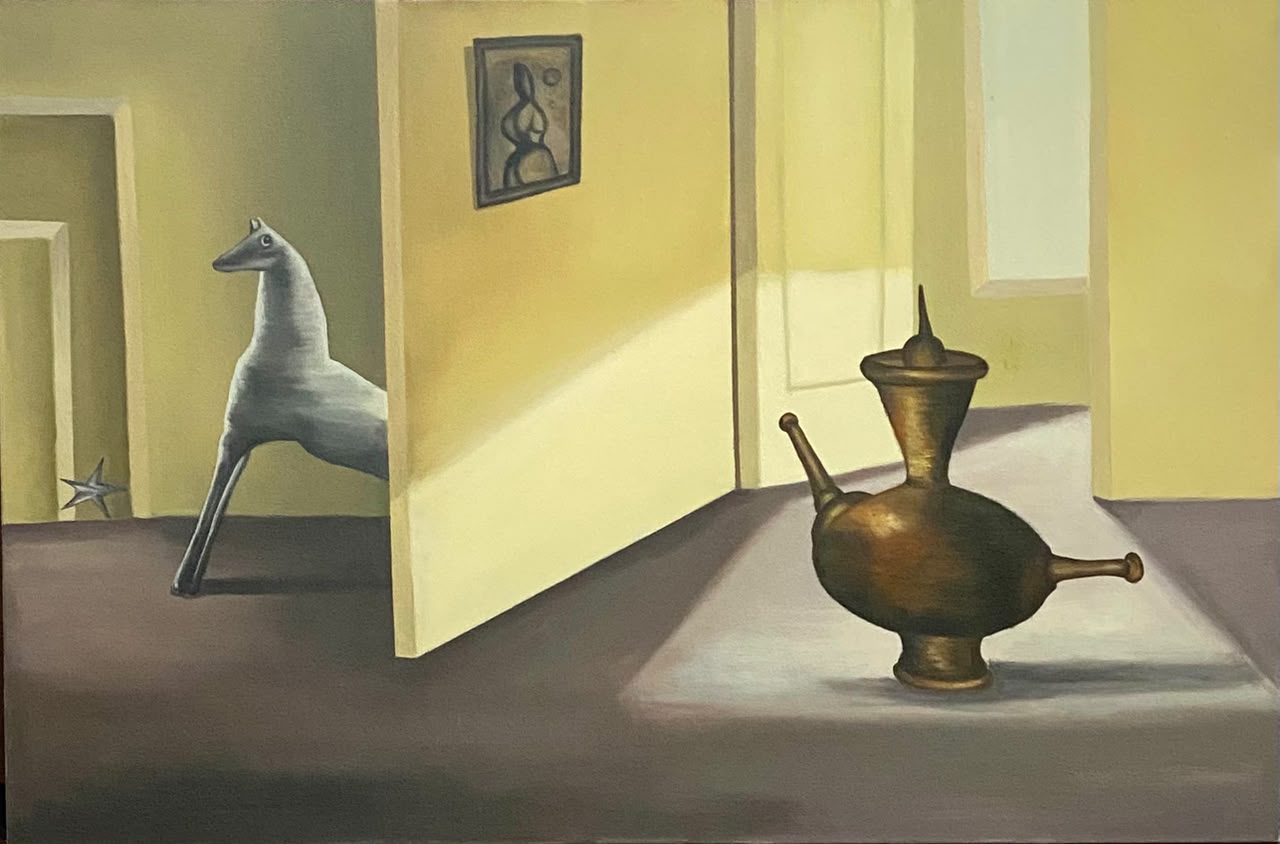
personal significance, incorporating his fantasy universe, for example, recall the yellow-tinged light that
permeated the artists’ childhood home, while his vast array of signs and symbols are often drawn from
his own dreams. Throughout this new body of work the artist gives space and form to his vivid inner
world, and the works collapse distinctions between body, architecture, fantasy and sacred geometry, to
create a universe where the self fantastically converges with the wider world. An airplane emerges to
greet the bird on the window sill. Defying conventions of perspectival space, Salvi’s works complicate
notions of figure and ground; in The Bird Song the central figure depicts a fantastical landscape, as if
another universe is springing forth from the subject’s head. The work’s striped; brightly-colored
background recalls the geometric compositions on the vibrant surfaces. Across Salvi’s patterned surface,
the central figure’s limbs cast long shadows, and the artists’ geometric worlds reveal traces of their
inhabitants at every turn, blending painting practices to thwart distinctions between interiority and
exteriority, figure and ground, and self and world. Representing their dreamlike universe, Prashant Salvi
considers space an expansive term that simultaneously encompasses both the public sphere and inner
fantasy.
For Salvi, these works explore psychological conditions, manifested in the physiology of the human
form. What Not to Wear on a Horse represents the synthesis of opposing forces, physical and
emotional, traditional and unexpected. The series challenges our accepted impressions of the world
around us. For this series, the artist contorts with images that evoke anthropomorphic physical qualities
and movement. Pulling the reference from his daily life and childhood, Salvi re-envisions in unexpected
contexts to challenge our perceptions of the objects in reality. True to Salvi’s practice, these works are
both familiar yet strange and evoke pause and contemplation from the viewer.
Abhijeet Gondkar
August 2026, Mumbai